Singapore’s 2025–2026 Wage Outlook: How NWC’s New Guidelines Will Shape Pay, Productivity, and Progress
This article is written in English for readers in Singapore. Chinese and Japanese translations are available on our website.
A Balanced Path Forward: Productivity Meets Fair Pay
Singapore’s wage direction for 2025–2026 is officially set. The Government has accepted the National Wages Council (NWC) Guidelines, reinforcing the principle that wage growth must align with productivity gains while remaining fair and sustainable.
Despite a softer global economy, Singapore’s fundamentals remain steady. In the first half of 2025:
- Real income grew by 3.2% year-on-year, showing continued improvement in workers’ purchasing power.
- Labour productivity rose 2.9%, with outward-oriented sectors (manufacturing, trade, finance, ICT) outperforming domestically driven industries.
- Unit labour cost fell by 0.2%, indicating that productivity outpaced wage increases — a key factor behind the Government’s support for productivity-driven growth.
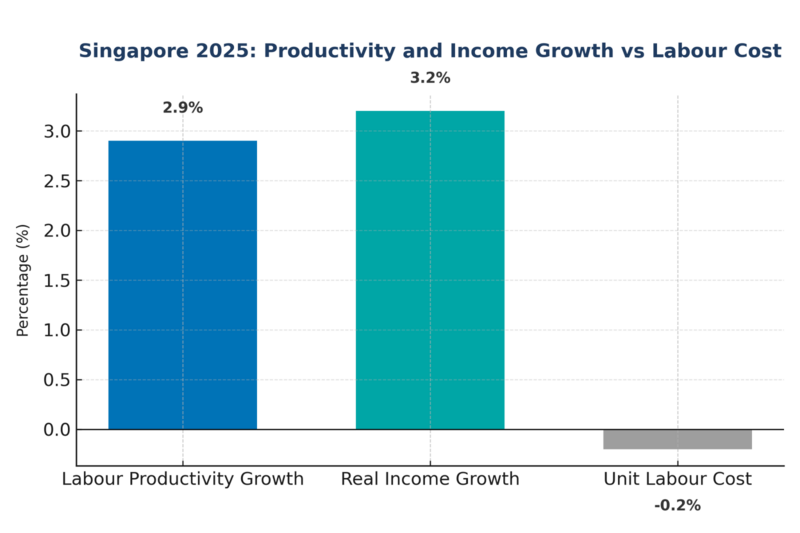
Chart: Singapore’s 2025 labour productivity and income growth outperform costs — signalling sustainable wage expansion.
However, signs of moderation are clear. Job vacancies and hiring intentions have eased, and the GDP growth forecast for 2025 now stands at 1.5%–2.5%, compared to 3.9% achieved in the first three quarters of 2025.
With continued uncertainty from global tariffs and geopolitical risks, both employers and employees are urged to adopt resilience strategies — including wage flexibility and continuous upskilling.
Key Highlights of the NWC 2025/2026 Guidelines
1. Fair and Sustainable Wage Increases
The NWC encourages employers to reward employees with built-in wage increases and variable payments (e.g. bonuses, annual variable components) based on business performance and productivity gains.
Employers who:
- Have done well should offer meaningful increments and fair bonuses.
- Have done well but face uncertainty may moderate increases but still offer variable pay.
- Have not done well should exercise restraint — but lead by example, invest in productivity, and plan future variable pay tied to business recovery.
The emphasis on productivity-linked pay reflects Singapore’s long-term commitment to sustainable wage growth without compromising competitiveness.
2. Flexible Wage System (FWS): A Must-Have for Resilience
|
At a Glance: What Is the FWS?
|
All employers are urged to adopt the Flexible Wage System (FWS) — a tripartite framework that helps companies adjust wages according to economic conditions, cutting costs instead of jobs during downturns, and retaining talent during upturns.
The FWS comprises:
- Monthly Variable Component (MVC) – allows monthly wage adjustments based on performance or conditions.
- Annual Variable Component (AVC) – typically reflected as bonuses or one-off payments.
Employers can reference the FWS Guidebook for implementation support or approach the Tripartite Alliance for Fair and Progressive Employment Practices (TAFEP).
This system enhances wage resilience — crucial in today’s volatile environment where adaptability defines business survival.
3. Uplifting Lower-Wage Workers (LWWs)
The Progressive Wage journey continues to gain momentum.
- Up to 9 in 10 full-time lower-wage workers now benefit from the Progressive Wage Model (PWM), Local Qualifying Salary (LQS), or Progressive Wage Mark schemes.
- The 2025/2026 Guidelines extend to workers earning up to $2,700 monthly (previously $2,500).
Employers who have done well are advised to provide:
- A built-in wage increase of 5.5%–7.5%, or at least $105–$125, whichever is higher.
| Category |
Recommended Wage Increase |
Notes |
|---|---|---|
| Lower-Wage Workers (≤ $2,700/month) | 5.5%–7.5% or $105–$125 | 5.5%–7.5% or $105–$125 |
| Administrators (OPW) | $2,170 → $2,360 | Effective July 2026 |
| Administrative Executives (OPW) | $2,760 → $2,940 | Effective July 2026 |
| Drivers (OPW) | $2,370 → $2,790 | Based on licence class, effective July 2026 |
🟦 These adjustments reflect the Government’s continued support for lower-wage sectors through the Progressive Wage Credit Scheme (PWCS).
This uplift covers 57,600 administrators and drivers, ensuring that occupations under the Occupational Progressive Wage (OPW) scheme also enjoy structured career ladders and meaningful pay progression.
Updated OPW wages (effective July 2026) include:
- Administrative Assistants: from $2,170 → $2,360
- Administrative Executives: from $2,760 → $2,940
- Drivers: between $2,370 → $2,790 depending on licence class
This move ensures fairer rewards while preserving business viability through Government co-funding via the Progressive Wage Credit Scheme (PWCS).
4. Upskilling, Reskilling, and Job Redesign
The NWC emphasises that sustainable wage growth requires productivity transformation — driven by skills upgrading and technology adoption.
However, training participation has fallen:
- Only 66.4% of employers provided structured training in 2024 (down from 79.6% in 2023).
- Just 52.6% of employees received training — a wake-up call to renew focus on lifelong learning.
Employers are encouraged to:
- Reskill mid-career staff using Workforce Singapore’s Career Conversion Programmes (CCPs) (salary support up to 90%).
- Redesign jobs with NTUC’s Company Training Committees (CTCs) — now backed by a $300 million grant until 2028.
- Build workplace learning systems through NACE Centres and SkillsFuture Queen Bee networks.
- Strengthen HR capabilities with the Institute for Human Resource Professionals (IHRP) certification — a national framework enhancing strategic HR practice.
For employees, the SkillsFuture Level-Up Programme and $4,000 top-up credits for mid-career reskilling remain pivotal tools. Both younger and experienced workers are urged to stay relevant in an AI-driven economy.
5. CPF Updates and Wage Implications
From 1 January 2026, the CPF monthly salary ceiling will rise from $7,400 to $8,000, reflecting Singapore’s evolving income landscape. Employer CPF contribution rates for workers aged 55–65 will also increase by 0.5 percentage points, partially offset by a CPF Transition Offset.
Employers should factor these adjustments when reviewing salary structures and wage increments, especially for experienced professionals nearing retirement age.
Why It Matters
The NWC 2025/2026 Guidelines strike a fine balance between protecting livelihoods and preserving business agility.
For companies, it’s a reminder that fair pay isn’t just a compliance measure — it’s a growth strategy tied to productivity, talent retention, and brand reputation.
For workers, it reinforces that lifelong learning is the new wage security. The more adaptable and skilled you are, the stronger your career resilience in a world shaped by AI and transformation.
Frequently Asked Questions (FAQ)
Q1: What is the Flexible Wage System (FWS)?
The FWS is a wage framework that allows employers to adjust pay during good or bad times. It consists of fixed, monthly, and annual variable components to balance competitiveness with job security.
Q2: How will the new NWC Guidelines affect my salary in 2026?
For most workers, wage adjustments will depend on company performance and productivity. For lower-wage workers, employers are encouraged to raise pay between 5.5%–7.5% or $105–$125, whichever is higher.
Q3: What support is available for training and upskilling?
Employers and employees can access programmes like the Career Conversion Programme (CCP), SkillsFuture Credit, and Company Training Committees (CTCs). SMEs can also seek funding via the SkillsFuture Workforce Development Grant (WDG) launching in early 2026.
Q4: Why does Singapore emphasise productivity-linked wages?
It ensures that wage growth aligns with long-term business sustainability and competitiveness, preventing inflationary pressure while rewarding real economic value creation.
| Building a Fair, Future-Ready Workforce Together Discover how Reeracoen connects top talent with purpose-driven employers. |
🎯 Ready to attract and retain top talent in 2026?
➡ Connect with our Reeracoen Consultants to strengthen your hiring and retention strategy.
💼 Looking to grow your career in a high-performing, fair-pay workplace?
➡ Explore opportunities with Reeracoen Singapore today.
✅ Final Author Credit
By Valerie Ong (Regional Marketing Manager)
Published by Reeracoen Singapore — a leading recruitment agency in APAC.
🔗 Related Articles
- [5 Pay Trends Every Employer Should Know for 2026]
- [Singapore’s Top 10 Most Competitive Roles for 2026]
- [Upskilling in the Age of AI & Green Jobs]
References
- Ministry of Manpower. (2025). Government accepts the NWC Guidelines for 2025–2026
- NWC 2025/2026 Guidelines PDF (MOM)
- NWC 2024/2025 Guidelines PDF (MOM)

Disclaimer:
The information provided in our blog articles is intended for general informational purposes only. It is not a substitute for professional advice and should not be relied upon as such.
While we strive to provide accurate and up-to-date information, the ever-evolving nature of certain topics may result in content becoming outdated or inaccurate over time. Therefore, we recommend consulting with qualified professionals or experts in the respective fields for specific advice or guidance. Any actions taken based on the information contained in our blog articles are solely at the reader's discretion and risk. We do not assume any responsibility or liability for any loss, damage, or adverse consequences incurred as a result of such actions.
We may occasionally provide links to external websites or resources for further information or reference. These links are provided for convenience and do not imply endorsement or responsibility for the content or accuracy of these external sources. Our blog articles may also include personal opinions, views, or interpretations of the authors, which do not necessarily reflect the views of our organisation as a whole. We encourage readers to verify the accuracy and relevance of information presented in our blog articles and to seek professional advice when needed. Your use of this website and its content constitutes acceptance of this disclaimer.
Related Post
 Singapore Has 68,600 Job Vacancies. So Why Is It Taking Longer to Find a Job?General
Singapore had 68,600 job vacancies in June 2026 and overall unemployment of just 1.9 percent. On paper, that looks like good news for anyone job...
 「I’m Here for You」―Reeracoen Wayが言葉を超えたときGeneral
フィリピンの、とある子どもたちが多く暮らす施設で、聞き慣れたメッセージが流れ始めました。 「I’m Here for You」 2026年8月、Reeracoen Singaporeのブランチマネージャー・須長が、Christian Mission Service Philippines...
- “我在你身边”:Reeracoen之道超越文字的时刻General
在菲律宾的一个儿童村,距离Reeracoen遍布亚洲的各个办公室很远的地方,一段熟悉的旋律开始响起。 “我在你身边。” 这一次,它不是写在演示文稿上,也不是在会议中说出的。 Reeracoen新加坡分公司经理砂贺正一(Shoichi...
- “I’m Here for You”: When the Reeracoen Way Became More Than WordsGeneral
In a children’s village in the Philippines, far from Reeracoen’s offices across Asia, a familiar message began to play. “I’m Here for You.” This...